
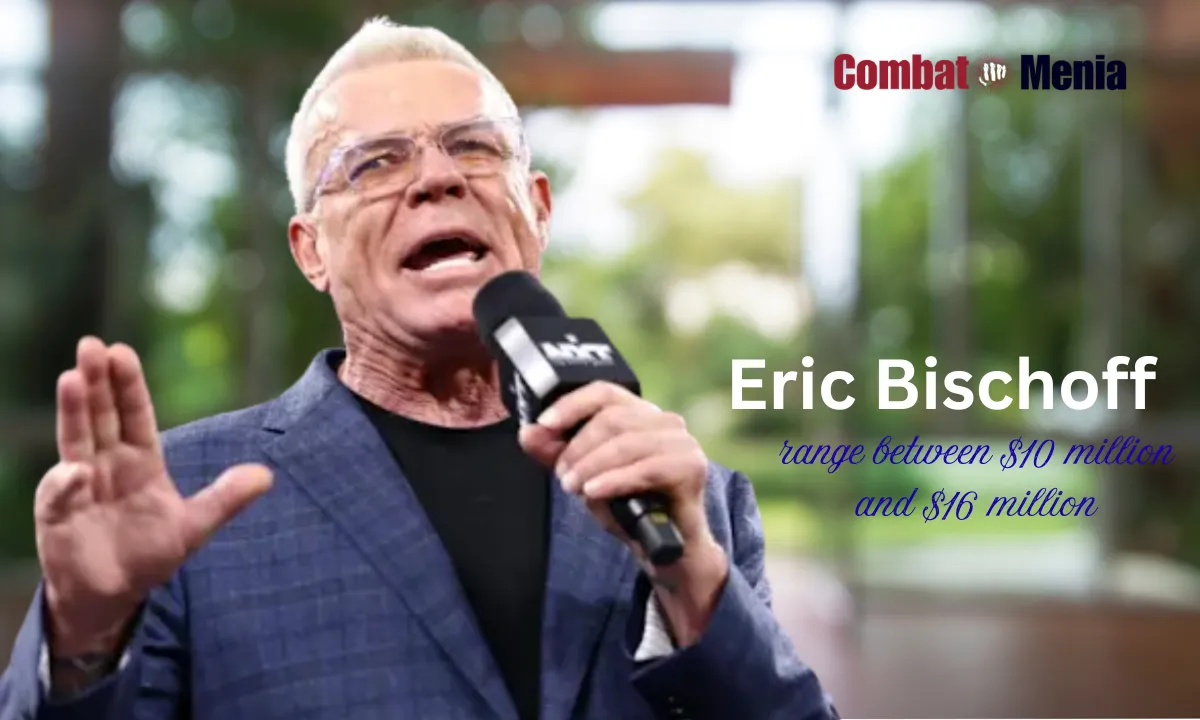
Net worth estimations for Eric Bischoff range between $10 million and $16 million, depending on what website you end up on. The difference is big enough to matter and detailed enough to be understood, but that understanding depends on knowledge about his actual earnings, his losses from a bankruptcy filing in 2017, and what he is building now.
Net worth of Eric Bischoff is estimated at $10 million according to the most accurate and the most commonly quoted sources like Celebrity Net Worth and SI.com. He is the guy who made WCW the top wrestling promotion in America, beat the competition in ratings of Monday Night Raw for 83 consecutive weeks, invented nWo, and then saw all that fall apart due to his mistakes and one angle with Hulk Hogan and a finger. This is how he got his money, why estimates differ and what he is doing in 2026.
Eric Bischoff Net Worth: The Headline Numbers
| SOURCE | ESTIMATE | RELIABILITY NOTE |
| Celebrity Net Worth (most widely cited) | $10 million | Primary reference for most mainstream sources. Used by SI.com and Sportskeeda. |
| ITRWrestling biographical profile | $12.5 million | Detailed career-based estimate. Plausible upper range. |
| Multiple aggregator sites | $12.5 million | Consistent with ITR. Likely derived from the same underlying calculation. |
| Oreate AI / outlier sources | $16 million | Not corroborated by reliable filing-based analysis. Treat with caution. |
| Most defensible current estimate | $10 million to $12.5 million | Acknowledges the WCW peak salary history, the 2017 bankruptcy, and ongoing podcast/media income. |
Why Estimates Vary: The Gap Explained
The net worth figures ranging between $10 million and $16 million of Eric Bischoff have a good reason to do so. The figure of $10 million provided by Celebrity Net Worth seems to be the one taking into consideration the bankruptcy that occurred in 2017 that changed everything after his financially good time that passed during the peak years of WCW and production company called Bischoff-Hervey Entertainment. The figure of $12.5 million mentioned by some other websites might be the one taking into consideration some real estate and productions he had before the bankruptcy.
The $16 million is provided by a blog created by an AI, it is nowhere mentioned in sources directly related to his personal finances, there is no evidence of independent financial tracking that would prove that the figure is correct, and the best way to treat it is as an outlier.
What is clear with certainty: Bischoff made in excess of $1 million per year during his tenure as President of WCW, among the higher levels of executive pay in the industry at the time. Given the 2017 bankruptcy filing, it is certain that some of his wealth has been diminished via whatever combination of debts, obligations, and financial repercussions from the collapse of a profitable business into one that is losing $5 million per month in a relatively short time period. Earnings from the 83 Weeks Podcast and his work with RAF and Hulk Hogan add to current revenue streams, but they are likely not as significant as he saw in his executive heyday.
Full Biography: Before Wrestling, Eric Bischoff Did Everything Else
Eric Aaron Bischoff was born on May 27, 1955, in Detroit, Michigan, and raised in Pittsburgh, Pennsylvania. His path to professional wrestling was genuinely circuitous: he owned a landscape construction company, worked as a veterinary assistant, acted in a bank training video about fair lending practices, competed as an amateur kickboxer, and ran a butcher shop where he sold meat out of a delivery van. The biography of a man who eventually ran one of the most powerful sports entertainment companies in America begins with someone selling cuts of meat from a vehicle in Pittsburgh.
He joined the American Wrestling Association in Minneapolis in 1986, working initially in the sales department under Verne Gagne, the legendary AWA promoter and founder. He transitioned into an on-air role as an interviewer and host before leaving in 1990 after the AWA began its terminal decline. After an unsuccessful tryout for an announcer position with what was then the WWF, he joined World Championship Wrestling in 1991 as an announcer, debuting at The Great American Bash.
The WCW Years: Peak Earning and Peak Power
Rising Through the Ranks: 1991 to 1994
Bischoff spent two years at the WCW announce desk before applying for the Executive Producer role that opened following the firing of Bill Watts in 1993. He secured the position, reportedly beating out Tony Schiavone and Jim Ross, two announcers he had been working under. By 1994, he had been promoted to Senior Vice President.
His most consequential act in that role was convincing Turner Broadcasting executives to substantially increase WCW’s budget and ambitions. He argued that the company could genuinely compete with the WWF rather than coexist with it at a respectful distance, and that doing so required real money spent on real talent. The argument was accepted. The first major result was signing Hulk Hogan away from the WWF in 1994, a signing that was genuinely unprecedented at the time and that transformed WCW’s commercial standing almost immediately.
WCW Nitro and the Monday Night Wars: 1995 to 1997
In September 1995, Bischoff launched WCW Monday Nitro on TNT, airing live and head-to-head against the WWF’s Monday Night Raw. The tactical innovation that followed defined the entire period: Bischoff began spoiling the results of Raw on air, since Raw was still taped at this point and the results were known in advance. It was a direct, aggressive competitive move that worked. Viewers who knew what was going to happen on Raw had no reason to watch the delayed broadcast when they could watch Nitro live instead.
The formation of the New World Order in 1996, built around the acquisitions of former WWF stars Scott Hall and Kevin Nash, and anchored by Hulk Hogan’s heel turn, was Bischoff’s creative masterstroke. The nWo blurred the line between wrestling fiction and apparent reality in a way that had not been done before, and it drove WCW to unprecedented ratings. By 1997, WCW Nitro had defeated Raw in television ratings for 83 consecutive weeks, and WCW had overtaken the WWF as the most-watched wrestling promotion in the United States. Bischoff’s official title was elevated to President of WCW.
At this peak, his annual salary exceeded $1 million, making him one of the highest-paid executives in sports entertainment. The combination of executive compensation and the commercial success of the company he was running placed him at his maximum earning power during these two or three years.
The Decline: 1998 to 1999
The WWF ended WCW’s ratings dominance in April 1998, driven by the Attitude Era and new stars including Stone Cold Steve Austin, The Rock, and Mick Foley. Bischoff’s response, which involved pushing established older talent over younger stars and allowing the nWo to become bloated and unfocused, accelerated WCW’s decline rather than arresting it.
The defining low point came on January 4, 1999, in an event that became known as the Fingerpoke of Doom. Kevin Nash, the WCW World Heavyweight Champion, dropped the title to Hulk Hogan when Hogan simply poked him in the chest with one finger and Nash fell to the mat. The segment was designed as a swerve, but it was received as an insult by a fanbase that had been watching WCW creative deteriorate for months. The fallout was swift and significant.
By mid-1999, WCW was losing an estimated $5 million per month. In September 1999, Bischoff was relieved of his management duties. He returned briefly in an on-air capacity alongside Vince Russo in 2000, WCW’s final desperate attempt at a creative resurrection, but left following a falling-out with Russo. WCW was sold to the WWF in 2001 for a fraction of what it had been worth at its peak, ending one of the most dramatic corporate declines in sports entertainment history.
After WCW: WWE, TNA, SmackDown and What Each Paid
WWE Raw General Manager: 2002 to 2005
Eric Bischoff was hired by WWE in 2002 to play the on-air General Manager of Monday Night Raw. This job was more of a performance one than a functional one but still gave him TV exposure for three continuous years. This was an on-screen persona who was a heel authority and often feuded with other wrestlers and characters. The heel authority persona played by Eric Bischoff also played an important part in WWE’s brand division authority system. This was an on-screen character who was fired in late 2005 in a very dramatic fashion when John Cena body slammed him, Vince McMahon got him into a garbage truck, and he drove off from the arena after a mock trial of all his on-screen misdeeds. His pay is undisclosed.
TNA: 2010 to 2014
Bischoff made a deal for TNA and Hulk Hogan in 2009, leading to their debut on Impact Wrestling in 2010. He was an executive producer and a representative figure in front of the screen for TNA for about four years. The time that he spent working for TNA did not prove successful, as people believe that TNA failed to replicate the WCW atmosphere in its entirety. In 2014, Bischoff left TNA, whose pay has not been disclosed yet.
WWE SmackDown Executive Director: 2019
Hiring of Bischoff in WWE as an Executive Director of SmackDown in 2019 was done in reality for a behind the scenes creative role and not as a performer. This lasted for about three months. It is reported that he was let go by WWE in October 2019. The reason for his short period in this role could be the lack of fit creatively or restructuring of this position to make it redundant.
Bischoff-Hervey Entertainment: The Production Company
After leaving WWE the first time, Bischoff founded Bischoff-Hervey Entertainment in 2003 along with Jason Hervey who is an American actor and producer who starred in The Wonder Years as Wayne Arnold. Bischoff-Hervey Entertainment is a production company that is headquartered in Los Angeles and produces various television content including reality and entertainment shows. One of the early productions of BHE included producing a pay-per-view event for WWE called “Girls Gone Wild.”
BHE ran for more than sixteen years from 2003 to 2019 where it became defunct. During this period, BHE showed Bischoff’s diversification of income sources from wrestling and executive performances to production and television revenues. The revenue generated by a production company for more than sixteen years is not an insignificant part of a net worth number. This is one of the reasons why net worth of $10 million to $12.5 million range is more justified than lower estimations that only consider revenue generated by Bischoff from wrestling performances.
The 2017 Bankruptcy: What It Means for the Net Worth Question
However, it must be noted that in 2017, Eric Bischoff declared bankruptcy, which is a verified fact and important information for any accurate estimation of his net worth trend. It cannot be said for sure what kind of bankruptcy this was, how much money were involved, what led to the situation, and how the process ended, but it should be clear that by 2017, several years after his last time in WWE and winding down of BHE, his finances were poor enough to require the bankruptcy proceeding.
The reason why this fact should be considered in relation to his net worth issue is the fact that some of the wealth he amassed in the years of his peak success with WCW and his own production company was apparently lost. This makes the estimation of $10 million more likely than the pre-bankruptcy estimations.
Current Income: 83 Weeks, RAF and What He Earns Now
The first ongoing source of income for Eric Bischoff comes from the 83 Weeks with Eric Bischoff podcast in conjunction with Conrad Thompson who is known as a wrestling journalist. As part of his podcast, Eric Bischoff discusses the history of WCW Monday Night Wars era week-by-week based on its TV episodes. Due to the fact that the podcast has gathered quite a considerable audience interested in this topic, the income from such a podcast can be generated via platform earnings, advertisements, appearance fees, merchandise, all of which are not publicly disclosed sources.
In 2025, Bischoff joined Hulk Hogan’s Real American Freestyle wrestling organisation, a competitive wrestling venture that launched on Fox Nation blending elements of amateur and professional wrestling. His involvement, confirmed by multiple sources, extends his ongoing media presence beyond the podcast format and into a new promotional role alongside his oldest professional partner.
Additional income comes from wrestling convention appearances, autograph sessions, occasional WWE programming appearances, and the ongoing commercial value of his association with the Monday Night Wars era, which remains one of the most heavily documented and revisited periods in wrestling history. WWE content on streaming platforms, including the Peacock archive, generates passive commercial value for those associated with it even without direct per-stream compensation for individuals.
Personal Life: Cody, Wyoming and the Family
Eric Bischoff has been married to his wife Loree for over forty years. The couple has two children: a son, Garett Bischoff, who had his own brief professional wrestling career most notably in TNA, and a daughter named Montanna. The family lives in Cody, Wyoming, a town in the northwestern part of the state that sits near Yellowstone and reflects a deliberate preference for a quieter, less public life than the Los Angeles-based production years might have suggested. Bischoff has invested in Wyoming-based ventures including Buffalo Bill Cody Beer, a craft brewing investment that reflects a personal interest in the local community and culture of where he lives.
Eric Bischoff Net Worth: The Honest Summary
| INCOME SOURCE | PERIOD | ESTIMATED CONTRIBUTION |
| AWA salary (announcer/interviewer) | 1986 to 1990 | Modest. Early career income, unlikely to be a significant net worth contributor. |
| WCW salaries (announcer, EP, SVP, President) | 1991 to 1999 | Substantial. Peak salary over $1 million per year as President during WCW’s peak commercial period. |
| WWE Raw GM role | 2002 to 2005 | Undisclosed. Three years of sustained on-screen work at WWE’s main show level. |
| Bischoff-Hervey Entertainment | 2003 to 2019 | Sixteen years of television production revenue. Meaningful diversification of income. |
| TNA executive/on-screen role | 2010 to 2014 | Undisclosed. Four years at a smaller promotion than WCW or WWE. |
| WWE SmackDown Executive Director | 2019 | Three months. Compensation undisclosed and period too short for significant contribution. |
| 83 Weeks podcast | Ongoing | Sustainable ongoing income from a well-established wrestling media property. |
| RAF involvement with Hulk Hogan | 2025 to present | New income stream. Scale undisclosed but adds commercial relevance. |
| Wrestling conventions, appearances | Ongoing | Standard appearance fee income for a WWE Hall of Famer. |
| 2017 bankruptcy filing | 2017 | Confirms net worth erosion occurred between peak earnings and current position. |
Frequently Asked Questions: Eric Bischoff Net Worth
Eric Bischoff’s net worth is most reliably estimated at $10 million, based on Celebrity Net Worth and corroborated by SI.com and Sportskeeda. Some sources cite $12.5 million as a plausible upper range. The discrepancy between estimates reflects the difficulty of accounting for his 2017 bankruptcy filing, the sixteen-year run of Bischoff-Hervey Entertainment, and the gap between his WCW peak salary of over $1 million annually and his current income from the 83 Weeks podcast and RAF involvement.
Eric Bischoff made his money primarily through his executive role at WCW, where his annual salary exceeded $1 million at his peak as President of the company during the Monday Night Wars era of the mid-to-late 1990s. Additional income came from his WWE Raw General Manager role, his TNA executive and on-screen work, the sixteen-year Bischoff-Hervey Entertainment production company, ongoing podcast revenue from 83 Weeks, and wrestling convention appearances.
Yes. Eric Bischoff filed for bankruptcy in 2017. The specific details of the filing have not been fully reported publicly, but the fact of the filing is documented and is relevant to any assessment of his current net worth, as it indicates a period of financial difficulty between his most lucrative wrestling years and the present.
In 2026, Eric Bischoff co-hosts the 83 Weeks with Eric Bischoff podcast alongside Conrad Thompson, which revisits his time in WCW and the Monday Night Wars era. He is also involved with the Real American Freestyle wrestling organisation, which he and Hulk Hogan launched in 2025 on Fox Nation. He was inducted into the WWE Hall of Fame in 2021 and makes occasional appearances in wrestling media and at conventions.
Eric Bischoff served as an announcer, then Executive Producer, then Senior Vice President, and finally President of World Championship Wrestling. As President from 1997, he was the driving force behind WCW’s most commercially successful period, including the creation of WCW Monday Nitro, the signing of Hulk Hogan, the formation of the New World Order, and the 83-week ratings winning streak over WWE’s Monday Night Raw.
Eric Bischoff earned more than $1 million annually as President of WCW during the company’s peak commercial period in the mid-to-late 1990s. This represented his highest single-year earnings across his career and is the primary foundation of whatever accumulated wealth he retained after the WCW collapse and the 2017 bankruptcy filing.
From $10 Million to the Monday Night Wars: The Only Honest Number
The net worth of Eric Bischoff is $10 million, which means much more than most other wrestlers’ net worths in the wrestling business. This figure stands for everything he made as a remnant of his career that included the most successful time in WCW history, his own production company, which lasted for sixteen years, WWE and TNA experience, bankruptcy in 2017 that put him back on zero, and finally money from podcasting that turned out to be the ultimate audio version of Monday Night Wars. The guy who signed Hulk Hogan, organized WCW Nitro, beat Raw for 83 weeks in a row, saw it all crumble down under the Fingerpoke of Doom, and returned to organize a wrestling business for Fox Nation with Hogan in his seventies is worth $10 million approximately. The number is accurate. The story is even more interesting.
Also read: Alicia Fox: WWE Career, TNA Return and Full Story